V4 · .NET 10 · Blazor Web App · VSA · MudBlazor

Blazor CRM Source Code

Customer Relationship Management — Complete Source Code

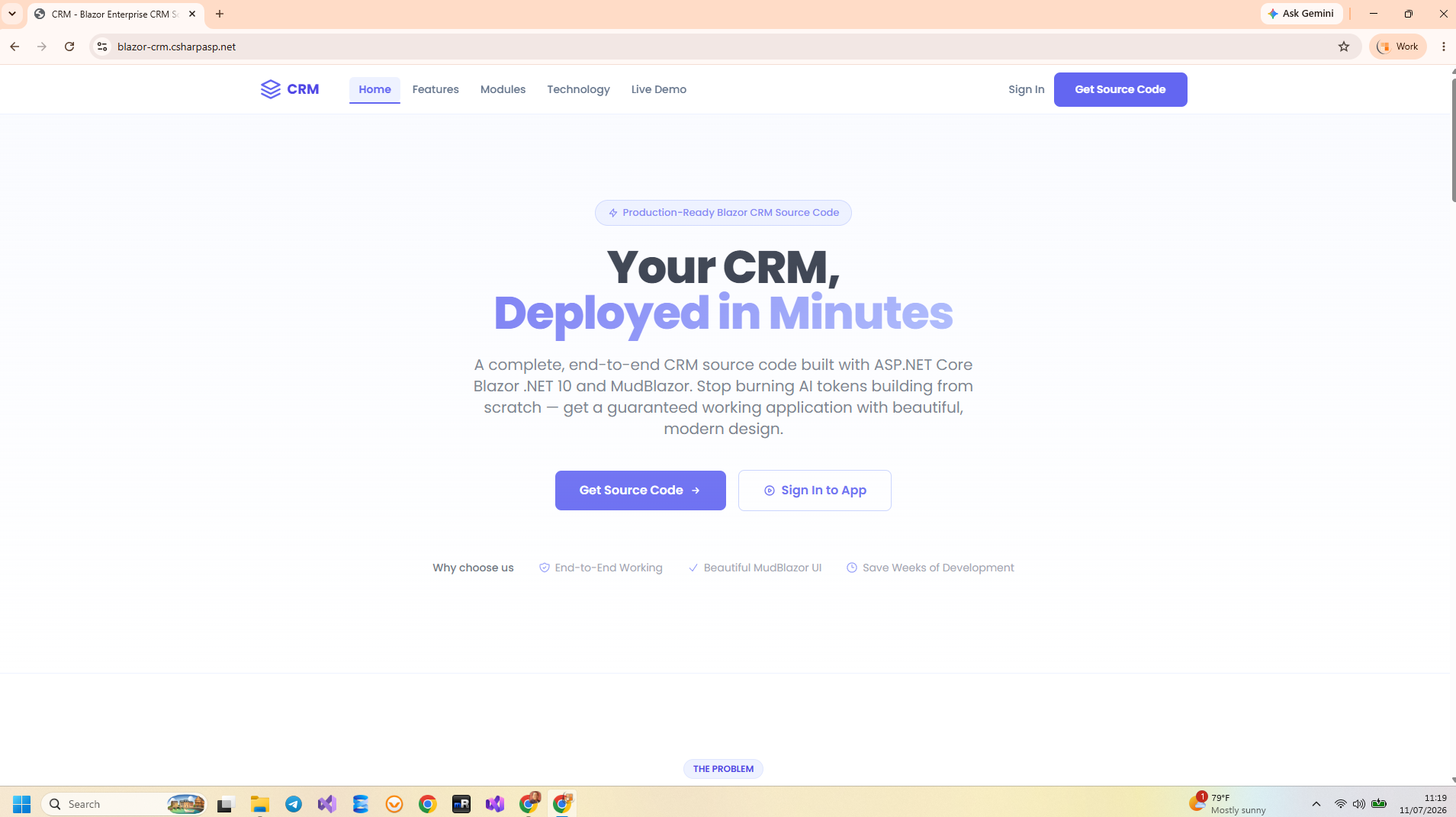
A production-ready CRM application to manage contacts, companies, sales pipeline, leads, and customer relationships. Built with .NET 10, ASP.NET Core, Blazor Web App (interactive server), MudBlazor and Vertical Slice Architecture — V4 adds multi-branch scoping, plain CQRS handlers wired to Minimal API endpoints, and three database providers.

$21 $49
Instant Download
Buy Now — $21 via Lemon Squeezy
cards
Powered by paypal
Live Demo
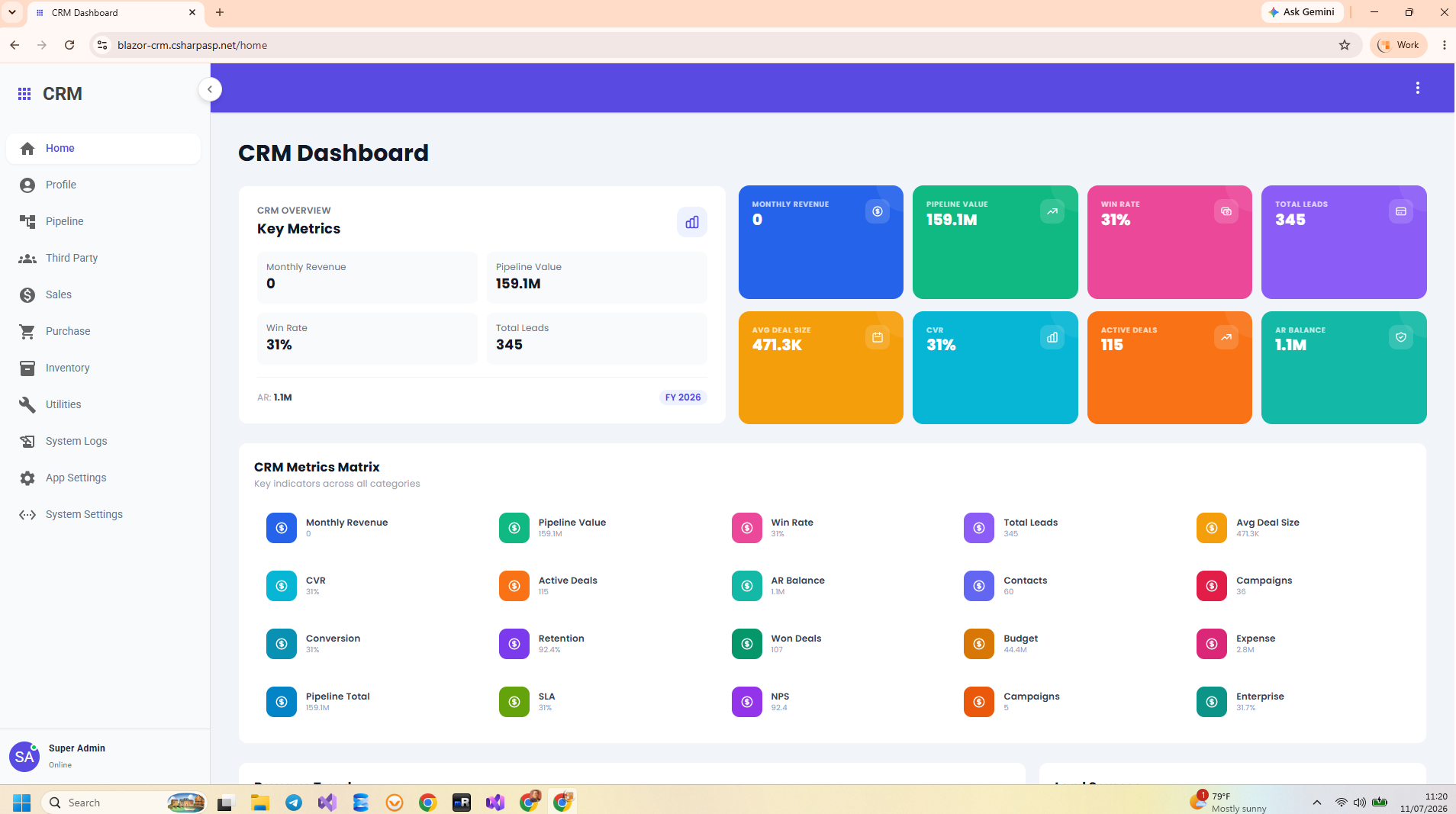
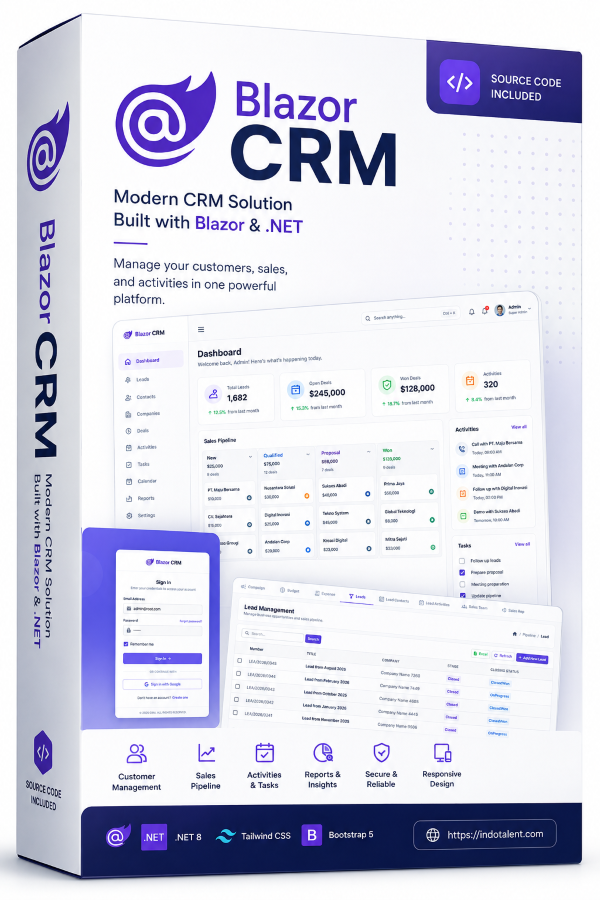
Blazor CRM Dashboard — Customer Relationship Management .NET 10 Blazor Web App
NEW · V4

What's New in V4

The V4 upgrade keeps every business module and adds multi-branch operations on a completely rebuilt application architecture.

Multi-Branch Operations

Organize records per branch. A protected Head Office branch is seeded on startup, forms expose a Branch selector, lists show a searchable Branch column, and 32 entity classes are branch-scoped — deleting a branch that is in use is blocked.

CQRS Without MediatR

Every operation is a plain handler class with a single HandleAsync(). Blazor pages resolve handlers through HandlerInvoker with a fresh DI scope per call, while Minimal API endpoints inject the same handler directly. No dispatcher, no pipeline magic.

Per-Feature Minimal API

The HTTP surface is rebuilt as one Minimal API group per feature (/api/{entity}): paginated lists, /export, /{id}/items, /{lookup}-lookup and create/update/soft-delete routes — all documented in Swagger/OpenAPI.

JWT Refresh Rotation + Firebase SSO

Short-lived access tokens with SHA-256 hashed refresh tokens and rotation, Identity cookies for the Blazor circuit, and optional Google sign-in via Firebase SSO.

Three Database Providers

InMemory (zero-config), SQL Server and PostgreSQL ship in the box — switch with a single IsUsed toggle in appsettings.json; the database is auto-created and seeded on startup.

Built-In Ops Stack

Hangfire jobs and dashboard, Serilog logging, health checks, an Admin Ops metrics dashboard, OpenTelemetry (OTLP) export and four rate-limiting policies.

The Problem

Business Problems Solved by Blazor CRM

Every business needs to manage customer relationships — but fragmented tools, manual tracking, and disconnected data cost time and revenue.

Scattered Customer Data

Sales teams store contacts in spreadsheets, email inboxes, and personal notes. No central source of truth means missed follow-ups, duplicate entries, and lost opportunities. Blazor CRM centralizes all contact, company, and deal data in one searchable, organized system with complete history tracking.

No Sales Pipeline Visibility

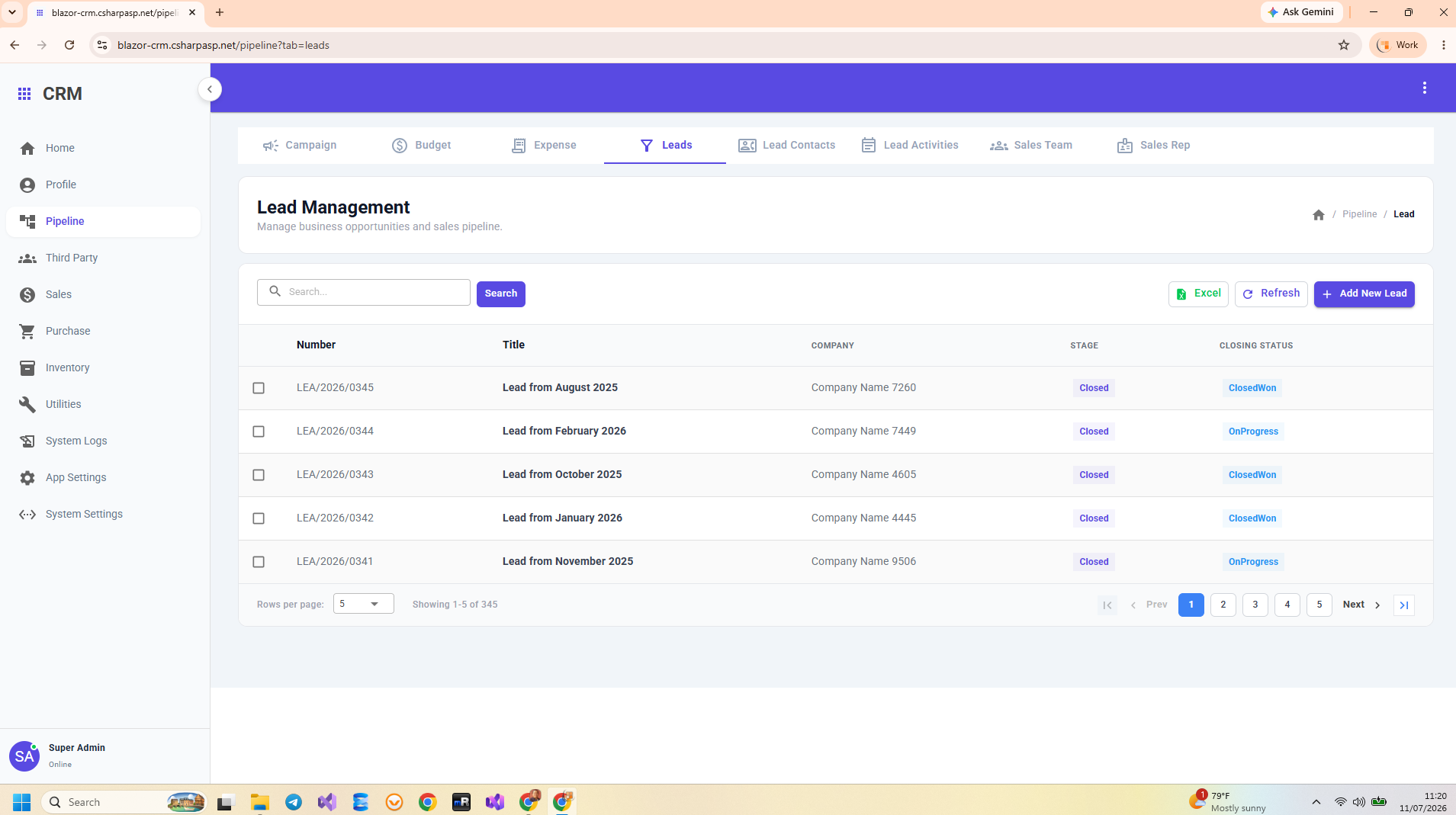
Without a structured pipeline, managers cannot forecast revenue or identify bottlenecks. Deals get stuck without anyone noticing. Blazor CRM provides a visual sales pipeline with deal stages (Prospecting, Qualification, NeedAnalysis, Proposal, Negotiation, DecisionMaking, Closed), with closing status ClosedWon / ClosedLost, so you always know where every deal stands.

Missed Follow-Ups & No Activity Tracking

Critical follow-ups slip through the cracks when there is no logging system. Blazor CRM tracks every activity — calls, emails, meetings, notes — and links them to contacts and deals. Complete activity timeline for every customer relationship.

No Actionable Insights

Without dashboards and reports, management flies blind. Blazor CRM includes KPI dashboards with charts and summary cards showing pipeline value, win rate, conversion metrics, and sales performance — all powered by EF Core aggregation queries.

Business Features

What's Included in Blazor CRM

Complete end-to-end business features — every module is a complete vertical slice with Blazor pages, a plain CQRS handler, a FluentValidation validator, a Minimal API endpoint and EF Core queries.

Profile

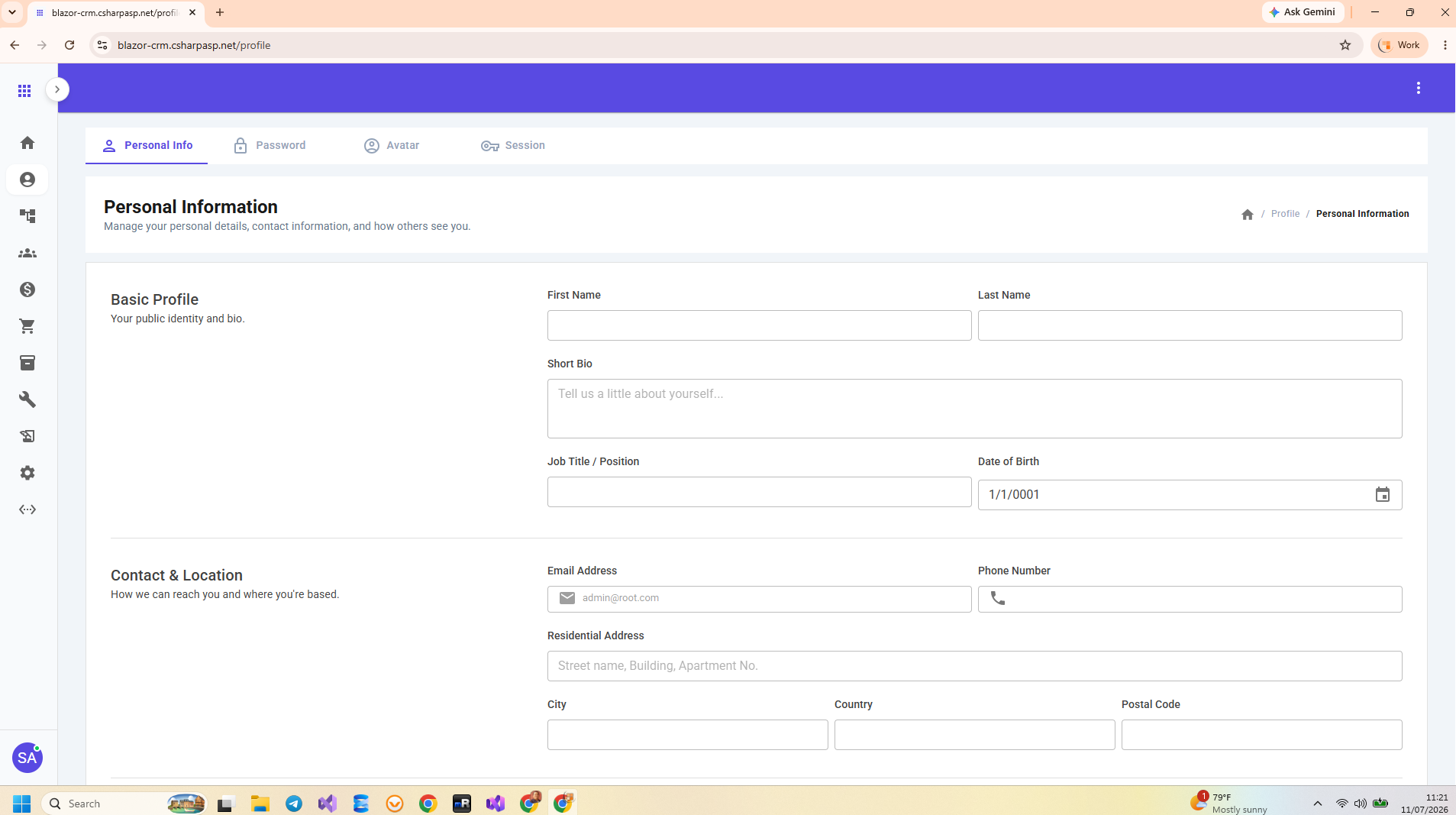
Personal Info, Password, Avatar, Session

Pipeline

CRM Dashboard, Campaign, Budget, Expense, Lead, Lead Contacts, Lead Activities, Sales Team, Sales Representative, Todo, Todo Dashboard

Third Party

Customer Group, Customer Category, Customer, Customer Contact, Vendor Group, Vendor Category, Vendor, Vendor Contact

Sales

Sales Quotation, Sales Order, Delivery Order, Sales Return, Credit Note, Invoice, Payment Receive — lists export to XLSX, Detail pages print to PDF

Purchase

Purchase Requisition, Purchase Order, Goods Receive, Purchase Return, Debit Note, Bill, Payment Disburse — lists export to XLSX, Detail pages print to PDF

Inventory

Unit Measure, Product Group, Product, Warehouse, Transfer Out, Transfer In, Positive/Negative Adjustment, Scrapping, Stock Count, Transaction Report, Stock Report, Movement Report

Utilities

Booking Group, Booking Resource, Booking, Program Manager, Program Resource, Payment Method

Monitoring & Logs

Health Check, Serilog logs, System File — plus the Hangfire dashboard at /hangfire

App Settings

Users, Roles, Tax, Country, Currency, Auto Number, Company, Branch

System Settings

full inspection mode for appsettings.json

AI Chat

ChatGPT / Claude / Gemini / DeepSeek (optional, bring your own API key)

Technology

Technologies Used

Blazor CRM is built on the modern .NET ecosystem with production-grade libraries and tools.

.NET 10 ASP.NET Core 10 Blazor Web App (Interactive Server) MudBlazor ASP.NET Core Minimal APIs Entity Framework Core 10 CQRS Handlers (No MediatR) FluentValidation Swagger / OpenAPI SignalR Hangfire Serilog Firebase SSO
LayerTechnology
Framework.NET 10
Web FrameworkASP.NET Core 10
UI RenderingBlazor Web App — Interactive Server render mode (SignalR circuit)
UI Component LibraryMudBlazor (Material Design components for Blazor)
UI AssetsSheetJS (Excel export), jsPDF (PDF print), ECharts (dashboards)
Architecture PatternVertical Slice Architecture (VSA) via ASP.NET Core Areas + CQRS plain handlers (no MediatR)
API StylePer-feature Minimal API groups (/api/{entity}) with Swagger/OpenAPI
Data AccessEntity Framework Core 10 — code-first, auto-create on startup, DataTable paging/search/sort helpers
DatabaseInMemory (zero-config) / SQL Server / PostgreSQL — toggle IsUsed in appsettings.json
Branch ScopeIHasBranch + BranchId — 32 branch-scoped entities, protected Head Office branch
ValidationFluentValidation
AuthenticationASP.NET Core Identity + JWT access/refresh token rotation + Firebase SSO (Google)
AuthorizationRole-based (Guest / Member / Admin + per-area roles) + rate-limited endpoint policies
Real-TimeSignalR circuit (Blazor Web App interactive server mode)
Background JobsHangfire — dashboard at /hangfire, recurring jobs (daily log cleanup)
EmailMailKit — SendGrid / Mailgun / SMTP / Mailjet (switch via appsettings.json)
LoggingSerilog — rolling files, optional database sink and Seq, 3-day auto cleanup
ObservabilityHealth checks (/health/live, /health/ready) + Admin Ops metrics dashboard + OpenTelemetry (OTLP)
AI ChatOptional AI assistant — ChatGPT / Claude / Gemini / DeepSeek (provider + API key)
Architecture

Application Architecture

Blazor CRM uses Vertical Slice Architecture (VSA) with plain CQRS handlers wired directly into per-feature Minimal API endpoints — no MediatR dependency, and the modern, maintainable approach to building .NET applications.

Vertical Slice Architecture

Each feature (Lead, Campaign, Sales Order, Product, etc.) lives in its own folder under ASP.NET Core Areas with its Blazor pages, feature components, plain CQRS handlers, validators, and Minimal API endpoint all in one place. Zero coupling between features. Add a feature without touching unrelated code.

Folder structure: Areas/Main/Lead/ contains Pages/, Components/, Cqrs/, Endpoints/, and the entity fields definition — everything for that feature.

CQRS via Minimal API Endpoints

Commands (writes) and queries (reads) are separated into single-purpose handler classes — CreateLeadHandler, GetCustomerListHandler, GetInvoiceExportHandler. Every handler exposes one HandleAsync() method and returns ApiResponse<T>. There is no MediatR dependency and no pipeline magic: Minimal API endpoints inject the handler directly, while Blazor pages call the same handler through HandlerInvoker with a fresh DI scope per call. Read-only dashboards use EF Core AsNoTracking().

Example: GetCustomerListHandler receives a DataTableRequest (paging, search, sort) and returns ApiResponse<T>; CreateLeadHandler validates with FluentValidation then saves via EF Core.

Single-Project Monolith

The entire application — Blazor UI, REST API, business logic, data access, and authentication — lives in one .NET 10 project. No distributed complexity, no microservice overhead. Single F5 to run. Deploy as one unit to Azure, IIS, or Docker. Perfect for teams that value simplicity and velocity.

Project Structure Overview

Indotalent/
├── Areas/
│   ├── Main/                     # CRM dashboard, lead management, campaigns
│   │   ├── CrmDashboard/         # KPI dashboard (ECharts)
│   │   ├── Lead/                 # Lead + Lead Contact + Lead Activity
│   │   ├── Campaign/  Budget/  Expense/
│   │   ├── SalesTeam/  SalesRepresentative/
│   │   └── Todo/  TodoDashboard/
│   ├── ThirdParty/               # Customer, Vendor + categories, groups, contacts
│   ├── Sales/                    # Quotation, Order, Delivery, Return, Credit Note,
│   │                             # Invoice, Payment Receive
│   ├── Purchase/                 # Requisition, Order, Goods Receive, Return,
│   │                             # Debit Note, Bill, Payment Disburse
│   ├── Inventory/                # Product, Warehouse, Transfer, Adjustment,
│   │                             # Scrapping, Stock Count, Reports
│   ├── Utilities/                # Booking, Program Manager, Payment Method
│   ├── Admin/                    # User, Role, Tax, Country, Currency, Auto Number,
│   │   │                         # Company, Branch, Health Check, Serilog, System File
│   ├── AI/Chat/                  # multi-provider AI chat (ChatGPT/Claude/Gemini/DeepSeek)
│   ├── Identity/                 # Account pages (Login, Register, Manage)
│   ├── Public/                   # Home + built-in Documentation
│   └── Blazor/                   # App shell, layouts, HandlerInvoker, circuit services
├── Infrastructures/              # Auth, database, email, jobs, logging, OTel, rate limiting
├── Data/                         # Entities, enums, seeders, Identity migration
├── Shared/                       # ApiResponse, DataTable helpers, pagination
└── Program.cs                    # Single entry point with full configuration

Areas/Main/Lead/                  # Feature folder convention (VSA)
├── Pages/         # Index / Create / Edit / Detail (.razor)
├── Components/    # feature-local dialogs and forms
├── Cqrs/          # GetList/GetById/Create/Update/Delete handlers + validators
├── Endpoints/     # LeadEndpoint.cs -> /api/lead
└── LeadFields.cs  # entity field definitions
Security

Security & Authorization

Security is baked into the architecture from the ground up — not bolted on as an afterthought.

Blazor CRM ships with a fully configured authentication and authorization system. ASP.NET Core Identity manages users and roles with secure password hashing. JWT access tokens with SHA-256 hashed refresh tokens and rotation protect the REST API, Identity cookies authenticate the Blazor circuit, and Firebase SSO (Google) is optional. Both schemes run simultaneously.

Role-based access control (RBAC) restricts features by user role: Guest, Member, and Admin, plus per-area roles (Main, Sales, Purchase, Inventory, ThirdParty, Utilities, AI). Every API group also runs behind rate-limiting policies (global, authenticated, write, admin), and policy-based authorization provides fine-grained control for sensitive operations.

With Blazor Web App (interactive server mode), source code and connection strings never leave the server. All data access happens server-side via SignalR — zero exposure of database credentials or business logic to the client.

Security Features

  • ASP.NET Core Identity — User registration, login, password hashing, password reset
  • JWT + Refresh Token Rotation — Short-lived access tokens, SHA-256 hashed refresh tokens with automatic rotation; Identity cookies for the Blazor UI
  • Role-Based Access Control — Guest, Member, Admin + per-area roles (Main, Sales, Purchase, Inventory, ThirdParty, Utilities, AI)
  • Policy-Based Authorization — Declarative policies for fine-grained feature access
  • Firebase SSO — Optional Google sign-in via Firebase Authentication
  • Rate Limiting — Four endpoint policies: global, authenticated, write, admin
  • Audit Trail — Every create/update/delete logged with user ID and timestamp
  • SignalR Protection — Blazor Server connections secured with [Authorize]
  • Server-Side Code — Source code and DB credentials never leave the server
Integration

REST API & Integration

Blazor CRM exposes a complete REST Web API for all entities — ready for mobile apps, third-party integrations, and external systems.

API Endpoints

Every feature registers one Minimal API endpoint group. All endpoints are JWT-protected, role-authorized, rate-limited, and return an ApiResponse<T> envelope.

GET/api/customer— Customer list — DataTable paging, search, sort
GET/api/customer/export— Full Excel export (SheetJS download)
GET/api/customer/{id}— Get customer by ID
GET/api/customer/{id}/items— Related line items for a header record
GET/api/customer/{lookup}-lookup— Lookup options for form selectors
POST/api/customer— Create customer
PUT/api/customer— Update customer
DELETE/api/customer/{id}— Soft-delete customer

Every entity follows the same pattern — customer, vendor, lead, campaign, sales order, invoice, product, branch and more — with /export, /{id}/items and /{lookup}-lookup routes. Endpoints are registered per area via Map{Area}Endpoints().

API Features

  • Swagger/OpenAPI Docs — Interactive API documentation at /swagger
  • JWT Authentication — Access + refresh tokens with rotation — every endpoint requires a Bearer token
  • Request/Response DTOs — Clean separation from domain models
  • FluentValidation — Input validation on all endpoints
  • Server-Side DataTables — Paging, search, and sorting handled by CQRS list handlers
  • Excel Export — /export endpoints feed client-side .xlsx download via SheetJS; Detail pages print to PDF via jsPDF
  • Rate Limiting — Global, authenticated, write and admin endpoint policies
  • Mobile-Ready — Use the API to build mobile apps or integrate with external systems
Database & Deployment

Database & Deployment

Three database providers, auto-create and seed on startup, and flexible deployment options — ready to run in under 60 seconds.

Database

  • InMemory — Zero-config provider for instant evaluation (no database server needed)
  • SQL Server — Production provider, auto-created and seeded on startup
  • PostgreSQL — Production provider, switch with a single IsUsed toggle in appsettings.json
  • EF Core Migrations — Code-first approach with full migration history
  • Auto-Create & Seed — DatabaseSeeder + Demo Mode samples on startup; Identity schema migration included
  • Branch Seeding — Protected Head Office branch seeded on startup; backfill assigns Head Office to empty BranchId rows

Deployment Options

  • Azure App Service — Deploy directly from Visual Studio or GitHub Actions
  • IIS (Windows Server) — Standard ASP.NET Core publish to IIS
  • Docker — Containerize and deploy anywhere Docker runs
  • Windows / Linux / macOS — .NET 10 runs everywhere
  • Single Project — No distributed complexity. One publish, one deploy
  • Setup Time: Clone repo → choose a database provider → F5 → running in under 60 seconds

Application Screenshots

Explore the Blazor CRM interface — dashboards, contact management, sales pipeline, and more.

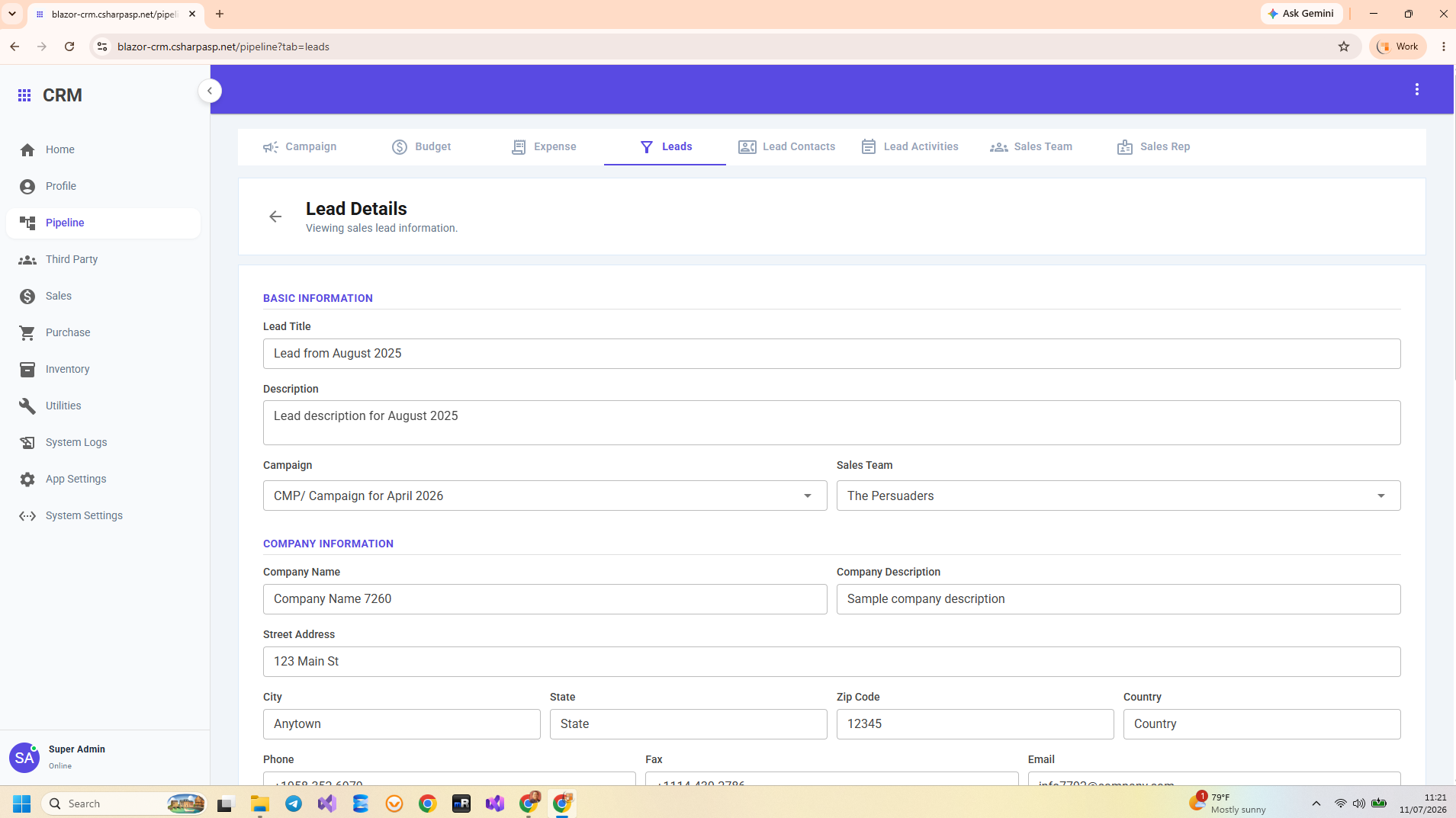
Blazor CRM Dashboard Blazor CRM Customer Master Blazor CRM Lead Pipeline Blazor CRM Sales Orders Blazor CRM Reporting & Analytics Blazor CRM Data Management

Try the Live Demo

Test every feature before you buy. No registration required.

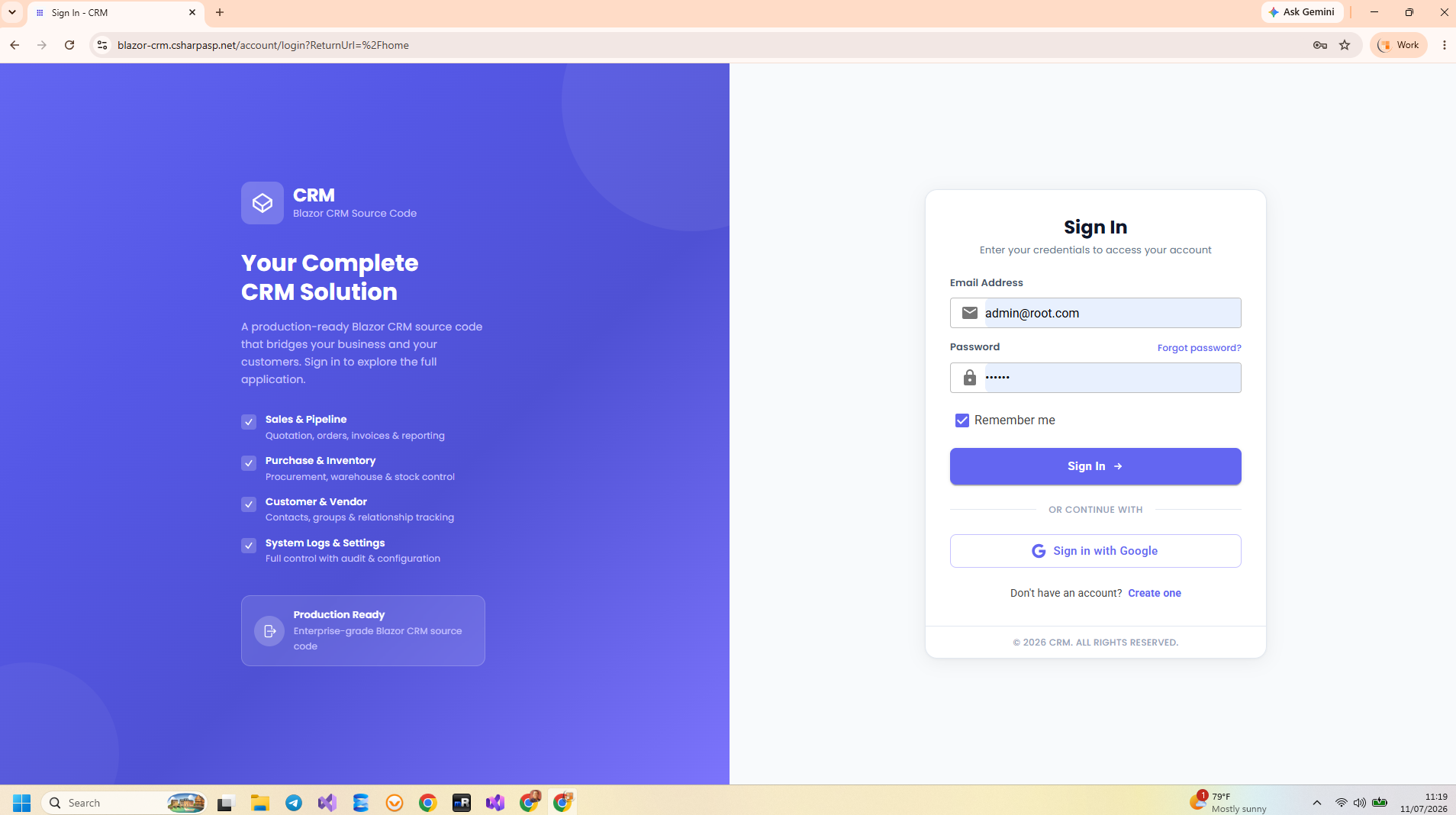
URL: https://blazor-crm.csharpasp.net/

Email: admin@root.com

Password: 123456

FAQ

Frequently Asked Questions

You get the complete, unrestricted C# source code of the entire Blazor CRM application — V4. A single .NET 10 project with all features: Vertical Slice Architecture, plain CQRS handlers, per-feature Minimal API endpoints, EF Core migrations and three database providers (InMemory, SQL Server, PostgreSQL). Clone, choose a database provider, press F5, and it runs immediately. Includes the Blazor Web App UI, REST API, authentication, authorization, audit trail, multi-branch scoping and all CRM features.
Yes! Each license covers one end product per client project. You can rebrand, customize, add features, and deploy for your clients. Freelancers and agencies save weeks of development. Each new client project requires a separate $21 license. See our License page.
Blazor CRM ships with three database providers: InMemory for zero-config evaluation, SQL Server, and PostgreSQL for production. Switch providers with a single IsUsed toggle in appsettings.json — the database is auto-created and seeded on startup.
Blazor CRM uses Vertical Slice Architecture (VSA) with plain CQRS handlers — no MediatR. Each feature lives in its own folder under ASP.NET Core Areas with Blazor pages, a single-purpose handler exposing HandleAsync() and returning ApiResponse<T>, a FluentValidation validator, and a Minimal API endpoint group. Blazor pages call handlers through HandlerInvoker, while Minimal API endpoints inject them directly. This pattern is AI-friendly, beginner-friendly, and production-proven. Read our VSA Introduction.
Absolutely! The code is clean, well-structured, and self-documenting. Beginners can study real production patterns — authentication flows, VSA feature organization, REST API endpoints, and database design — all in a single project. You'll need Visual Studio 2022+ and SQL Server (LocalDB or Express, both free).
Due to the digital nature of source code, we have a strict no-refund policy. That's why we provide a fully functional live demo — test every feature before you buy. Full policy here.
Yes — V4 adds multi-branch operations. A protected Head Office branch is seeded on startup and empty BranchId rows are backfilled to it. 32 entity classes are branch-scoped: forms include a Branch selector, lists show a searchable and sortable Branch column, and branches are managed at /Admin/Branch. Deleting a branch that is in use is blocked.
V4 adds multi-branch scoping (32 branch-scoped entities with a protected Head Office), CQRS plain handlers wired to per-feature Minimal API endpoints (no MediatR), JWT refresh-token rotation with optional Firebase SSO, three database providers (InMemory / SQL Server / PostgreSQL), and a built-in ops stack: Hangfire, Serilog, health checks, OpenTelemetry and rate limiting.

Get Blazor CRM Source Code

Complete, unrestricted C# source code. Single .NET 10 project.

$21 $49
Instant Download
Buy Now — $21 via Lemon Squeezy

or

cards
Powered by paypal

Secure checkout via PayPal or LemonSqueezy. No subscription.

MVC EDevKit

NEW · ASP.NET Core MVC

The Same VSA You Know. Now in ASP.NET Core MVC.

MVC EDevKit Basic is the MVC implementation of Vertical Slice Architecture — every feature lives in one self-contained folder with Controllers, CQRS handlers, per-feature Endpoints, and Razor Views.

  • MVC implementation of VSA — one folder per feature: Controllers, Cqrs handlers, Endpoints, Views + DataTables.
  • Production-grade & AI-Ready — included skill file generates a complete feature in 18 files from a single prompt.
  • 10 enterprise features pre-built — Identity + JWT + Firebase SSO, Hangfire, multi-provider email, Serilog, health checks.
More Detail
MVC EDevKit Basic ASP.NET Core MVC starter

7 Free Enterprise Manager Apps

Included free with every MVC EDevKit purchase
Asset ManagerComplete IT asset lifecycle management
Booking ManagerResource booking, approvals, check-in/out
Helpdesk ManagerInternal IT support ticketing
Invoice ManagerCreate, manage, track invoices
Meal ManagerMeal ordering for staff and guests
Project ManagerProjects, timesheets, and skill matrix
Roster ManagerEmployee shift scheduling